Mayor Carmella's new City Hall costs more than her deputy's charts show
Mayor Carmella Mantello's deputy says the move to Proctor's saves taxpayers money. His charts counted only the rent. The lease makes the City pay for heat, power, insurance and repairs too, and 30 years of payments come to about $20 million.
Jump to a section (8)
- He says the move saves you money
- His chart was drawn to make the savings look bigger
- His numbers don’t match each other
- His Proctor’s bars leave out what the lease makes you pay
- Thirty years of payments add up to almost twice what the project costs
- He said it was a triple net lease, then said it wasn’t
- He sits on both sides of the deal
- What the record shows
Troy’s City Hall moves into the old Proctor’s Theatre on Fourth Street in 2027. The City will pay the Troy Local Development Corporation about $670,000 a year for 30 years. On top of that, the City pays for the building’s heat, power, insurance and repairs.
Deputy Mayor Seamus Donnelly sold the move with charts that showed Proctor’s saving you money every year. On November 12 he posted that the project came in “on time, on budget, saving taxpayer dollars.”
His charts counted only the rent at Proctor’s. The lease puts everything else on the City. Add what buildings like this one usually cost to run, and Proctor’s costs more than his own figure for staying where City Hall is now, starting in year one.
30 years of payments
$20M
For an $11.2 million project
What his chart counted for Proctor's heat, power, insurance and repairs
$0
The lease makes the City pay all of them
Council vote on the lease
4 to 3
November 6, 2025
2025
The City gives notice it will leave 433 River Street at the end of 2026.See the record — The City gives notice it will leave 433 River Street at the end of 2026.
The deputy mayor signs the Proctor's deal for the development corporation.See the record — The deputy mayor signs the Proctor's deal for the development corporation.
The first cost chart starts at $0.See the record — The first cost chart starts at $0.
His memo sends the council the lease and a cost table.See the record — His memo sends the council the lease and a cost table.
He shows a new chart, and the council approves the lease 4 to 3.See the record — He shows a new chart, and the council approves the lease 4 to 3.
2026
He tells the council it is "not a traditional triple net lease."See the record — He tells the council it is "not a traditional triple net lease."
He posts that the project saved taxpayer dollars.See the record — He posts that the project saved taxpayer dollars.
He says the move saves you money
Our mayor made a promise, it was to control our city’s headquarters, a place that functioned better, one that made financial sense and brought pride back to the center of our local governance. We accomplished that, while being on time, on budget, saving taxpayer dollars, oh and plenty of parking!
In the same post he thanks people for the project “as deputy mayor and Troy Local Development Corp. executive director.” He holds both jobs. The City pays the rent, and the development corporation he runs collects it.
His chart was drawn to make the savings look bigger
This is the chart he showed the council on November 6, 2025, the night it voted.
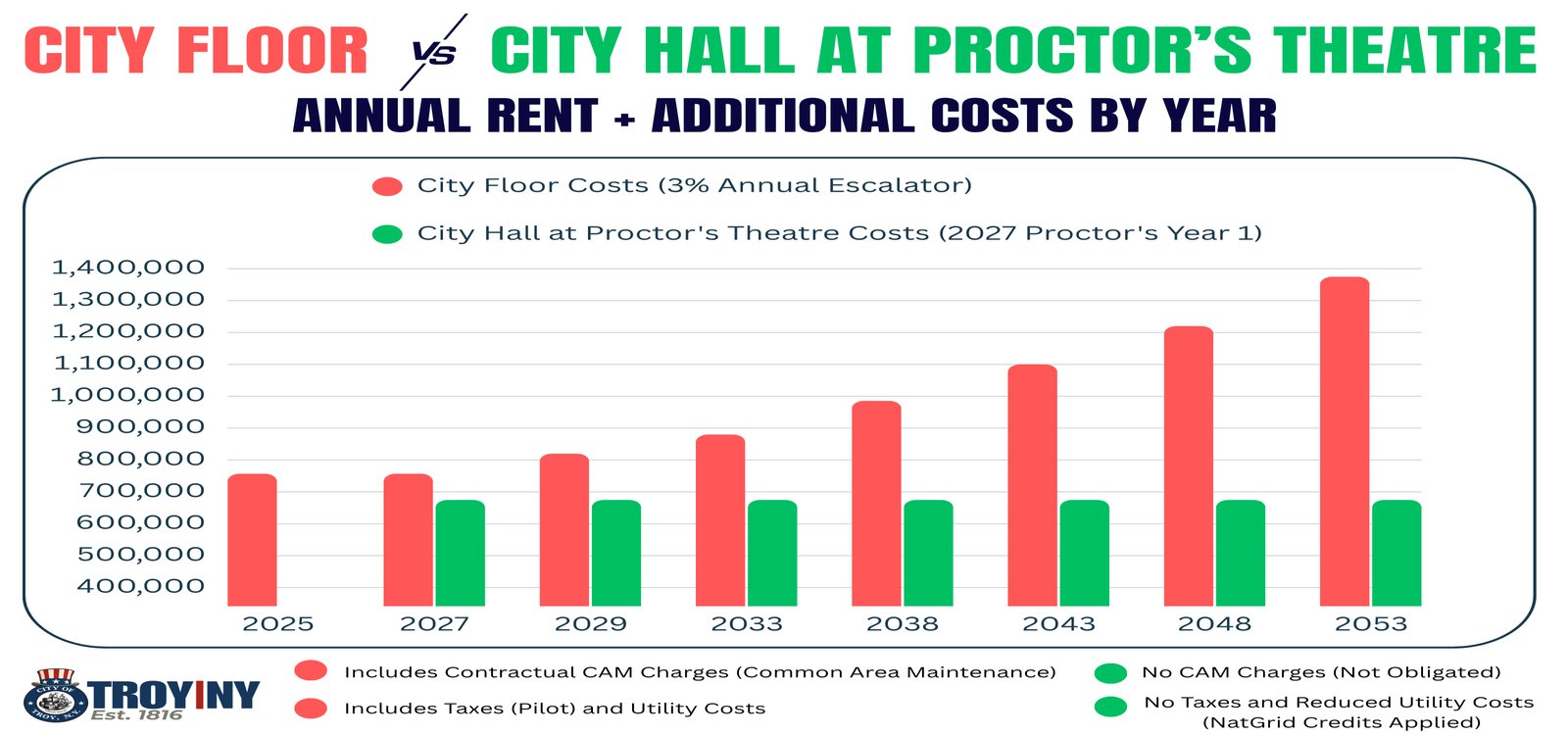
Look at the numbers on the left. The scale starts at $400,000, not $0, and the bars start near $340,000. Cutting off the bottom makes the gap look bigger than it is. In 2053, the red bar is drawn 3 times as tall as the green one, but by his own numbers it is only 2 times as much.
The years along the bottom are 2 years apart, then 4, then 5, but every gap is drawn the same width. That makes the later costs look like they climb faster than they do.
The chart he showed in July 2025 made the same comparison, and its scale started at $0.
This graph … is supposed to give a simple picture. This is not supposed to be a a indepth um breakdown of everything that we’re talking about.
His numbers don’t match each other
- The same year has two prices. For 2043, his July chart says staying would cost $1,334,613. His October memo says $1,097,811. That is about $237,000 less for the same year, with no explanation.
- A 3% raise that doesn’t rise. The chart’s legend says staying goes up 3% a year. The 2025 and 2027 bars are the same height, about $754,000. His own memo a week earlier put 2027 at $787,378.
- A table that doesn’t add up. The presentation lists River Street’s shared building charges. The six rows add to $587,586. The total printed under them is $176,984.
- Two sizes for one office. One page says City Hall’s River Street floor has 30,000 square feet. Two pages later, the lease he quotes charges rent on 36,435.
- A lease that was already over. Every red bar after 2026 is the cost of staying at River Street. The City had already given notice ending that lease on May 29, 2025, and the deputy mayor was copied on the letter.
His Proctor’s bars leave out what the lease makes you pay
The green bars on his chart are the rent and nothing else. The lease the council approved says the City pays for much more:
The Base Rent is a triple net figure and in addition to the Base Rent the City shall be responsible to pay taxes, utilities, insurance and maintenance and repairs.
Other sections put the roof, the foundation, the building’s structure, cleaning and snow removal on the City too. Proctor’s is a historic theater with 45,000 square feet, half again the size of the River Street floor.
The deputy mayor put the City’s utility bill at River Street at “60,000 or so roughly a year.” That works out to about $2 a square foot. At the same rate, Proctor’s would cost about $90,000 a year to heat and power.
Repairs and upkeep add more. Offices across the country spend about $2 a square foot a year on repairs, or about $90,000 for a building this size. Engineers who study public buildings say to set aside 2% to 4% of a building’s value every year for upkeep. On an $11.2 million project, that is $224,000 to $447,000 a year.
He told the council the night of the vote that the City would pay utilities at Proctor’s. He said repairs were left off the chart because they are “not a fixed cost.”
Thirty years of payments add up to almost twice what the project costs
The rent is set to pay off the bonds the development corporation sold to buy and rebuild the building. The Times Union reported first-year rent of $669,633, and the lease runs 30 years. That comes to about $20 million. None of his charts showed a total.
He calls it “on budget.” The price changed every time the public heard it:
- May 2025: about $8.25 million for construction, in the deal he signed
- July 2025: $8.6 million for renovation
- August 2025: “up to” $12.5 million in all
- October 2025: $11.2 million in all
- October 2026: $10.6 million in all
He said it was a triple net lease, then said it wasn’t
A triple net lease means the tenant pays the building’s taxes, insurance and upkeep. The night the council voted, he agreed that was the deal.
We are in a triple net lease. We are responsible for our maintenance.
A year later, Council Member Noreen McKee asked who pays the insurance at Proctor’s. He said the development corporation he runs would pay it, not the City. When she asked how that fits the lease, he said:
It ties into it because our board, although again, you are advocating to pass along that cost to taxpayers, has decided that it would take on that cost. … It’s not a traditional triple net lease.
The lease still says the City carries the insurance. Asked how much it costs, he said, “I’d have to get back to you on that exact number.” See how he answers the people who question him.
He sits on both sides of the deal
The Troy Local Development Corporation bought the building, sold the bonds and collects the rent. The deputy mayor is its chief executive and a voting member of its board. It pays him $20,000 a year on top of his City salary, up from $10,000. He did not vote on his own pay.
On May 29, 2025, the City gave notice it would leave River Street, and he was copied. The next day he signed the Proctor’s deal as the development corporation’s chief executive. The mayor signed for the City.
Council Member Tom Casey sat on the same board. In July 2025 he resigned from it so there would be “no misconceptions of impropriety.” The deputy mayor stayed. He told WAMC he sees no conflict because he is appointed, not elected.
What the record shows
The deputy mayor showed the council a chart that started at $340,000 instead of $0 and spaced the years evenly when they weren’t. His numbers for the same year changed between July and November, and his table of River Street charges does not add up. His Proctor’s bars counted only rent, though the lease makes the City pay for utilities, insurance and repairs. He called it a triple net lease the night of the vote and said it wasn’t one a year later. Thirty years of payments come to about $20 million for an $11.2 million project, paid to a development corporation he runs.
Sources
- Deputy Mayor Seamus Donnelly, Facebook post on the Proctor's walkthrough
- Ordinance 54 memo from Deputy Mayor Seamus Donnelly, with the proposed Proctor's lease
- Final Public Presentation, Proctor's City Hall, November 6, 2025
- New City Hall Public Meeting Presentation, July 23, 2025
- Proctor's City Hall letter of intent, May 30, 2025
- Termination of Lease letter for 433 River Street, May 29, 2025
- Updated Project Cost Chart, October 29, 2025
- Troy City Council meeting, November 6, 2025
- Troy City Council budget hearing, November 12, 2026
- Troy Local Development Corporation minutes and resolutions, March 28, 2025
- Troy Local Development Corporation agenda packet, March 20, 2026
- Troy councilman quitting LDC to avoid conflict
- Troy residents still seek more details regarding the proposed City Hall relocation
- Troy's new City Hall could cost up to $12.5 million, according to city officials
- Troy approves City Hall lease at Proctor's building
- Troy sets deadline to move City Hall to Proctor's
- BOMA releases office and industrial benchmarking reports
- Committing to the Cost of Ownership, Appendix A